
Human relationships—and our own sense of self—often suffer from a gap between how we see ourselves and how others see us. The Johari Window, a psychological tool developed in 1955 by Joseph Luft and Harrington Ingham, offers a very useful framework for exploring that gap, improving communication, promoting self-awareness, and fostering trust. It remains one of the clearest ways to explore how we see ourselves, how others see us, and how trust can grow when the two perspectives meet.
The Four Quadrants
The Johari Window divides personal awareness into four zones:
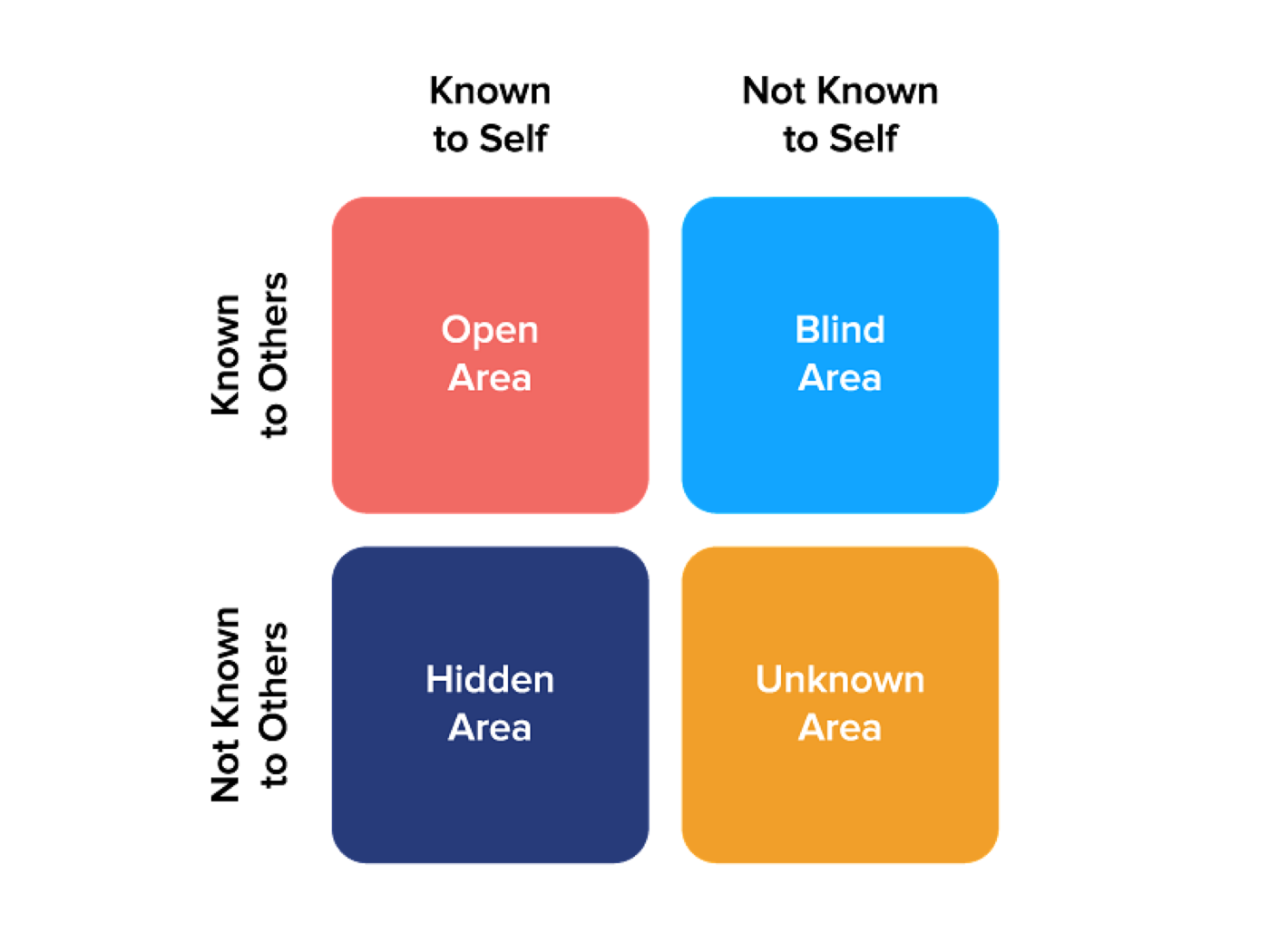
- Open Area: The space of transparency. Traits and behaviors you know about yourself, and others also recognize. Communication flows easily here.
- Blind Spot: The things others see in you, but you don't see in yourself—strengths, weaknesses, or habits. Feedback is essential here.
- Hidden Area: What you keep to yourself—your fears, dreams, or past experiences. Sharing selectively can build stronger trust.
- Unknown Area: The unconscious zone, where neither you nor others are aware of your potential, motivations, or untested abilities.
Why It Matters
You are going to understand why this model is powerful:
- Improve Communication: Expanding the Open Area reduces misunderstandings.
- Increase Self-Awareness: Feedback shrinks the Blind Spot and reveals hidden patterns.
- Build Trust: Sharing reduces the Hidden Area and fosters authentic relationships.
- Unlock Potential: Exploration and new experiences reduce the Unknown Area, revealing hidden talents.
How to Apply It
You are going to see that the Johari Window is not just theory—it is practice:
- Ask for Feedback: Encourage colleagues or friends to tell you how they perceive your behavior.
- Practice Self-Disclosure: Share thoughts or feelings that are relevant and safe, to deepen trust.
- Reflect: Journaling and coaching can reveal blind spots and unconscious drivers.
- Experiment: Taking on new challenges often uncovers unknown capabilities.
Growth and Discovery
Exploring the Unknown Area—through new experiences, coaching, therapy, or deep reflection—can unlock latent strengths or reveal blind motivations. Traditional coaching offers a powerful space to uncover these hidden dimensions by asking the right questions and creating a safe environment for exploration.
Today, a new layer is emerging with AI-coaching solutions, which make this process more accessible and immediate. By analyzing conversations, providing structured feedback, and nudging reflection in real time, AI-coaches can accelerate the journey of self-discovery while complementing human guidance.
Challenges and Limitations
You are going to recognize that the model also has boundaries:
- Oversharing can create discomfort in some contexts.
- Feedback requires a culture of safety; otherwise, it can damage trust.
- Cultural norms shape how much people are willing to disclose or comment.
- Some parts of the Unknown Area may only emerge with time or professional support.
You are going to realize that the Johari Window is ultimately about alignment. The more you grow the Open Area, the more trust, clarity, and effectiveness you create—both for yourself and for others. Whether in leadership, teamwork, or personal relationships, the journey is the same: reduce blind spots, share wisely, and explore what lies beneath the surface.
And now, with the rise of AI-coaching solutions, the Johari Window is gaining a new relevance: combining human trust and digital precision to expand awareness faster, and to make growth more tangible than ever.